Showing posts with label Disasters. Show all posts

Thursday, March 22, 2012

Amazing Sandstorm In Kuwait

At approximately 5.30 PM (GMT +3) a dust storm swept through Kuwait turning the setting evening sun to immediate darkness reaching minimal visibility in mere minutes. What first seemed to be smoke from a burning building, everyone soon started running for cover. Here's one of the first glimpse of, ironically, a rare spectacle, considering the location of the country!


Also, check this amazing video of Kuwait sandstorm:

Saturday, March 10, 2012

Tornado Formation Caught On Security Camera


Not something you see everyday.

Friday, March 9, 2012

World's Biggest Holes

1.The Diavik Mine

The Diavik Mine is a mine in the Northwest Territory of Canada. This mine was opened in 2003 and it produces 8 million carats or about 1,600 kg (3500 lb) of diamonds every year. It has become an important part of the regional economy, employing 700 people. Diavik Diamond Mine goes to 240 meters below the surface.


2.The Bingham Canyon Mine

The Bingham Canyon Mine is an open-pit mining operation extracting a large porphyry copper deposit southwest of Salt Lake City, Utah, USA, in the Oquirrh Mountains. It is owned by Rio Tinto Group, an international mining and exploration company headquartered in the United Kingdom. The Bingham Canyon pit is now 2.5 miles wide and very deep.The mine has been in production since 1906, and has resulted in the creation of a pit over 1.2 km (0.75 miles) deep, 4 km (2.5 miles) wide, and covering 7.7 km² (1,900 acres).


3.Chuquicamata, Copper Mine, Chile

Chuquicamata is also one of the biggest open pit copper mine in the world, located in the north of Chile, 215 km northeast of Antofagasta and 1,240 km north of the capital, Santiago. Its depth of 850 meters (2,790 ft) makes it one of the deepest open-pit mine in the world. It’s an industry that has begun since 1882, although it started operating properly in 1911 when US capitals finished its construction. Today, the production reaches the 630 tons of fine copper every year.


4.Darvaza Gas Crater – The Door to Hell

Derweze is a Turkmenistan  village of about 350 inhabitants, located in the middle of the Karakum desert, about 260 km north from Ashgabat. The Derweze area is rich in natural gas. In 1971 a Soviet drilling rig accidentally punched into a massive underground natural gas cavern, causing the ground to collapse and the entire drilling rig to fall in. Darvaza Gas Crater or the “Door to Hell” named by a localist is a 328 feet wide hole. This hole has been on fire, continuously, for the last 38 years.


5.The Great Blue Hole

The Great Blue Hole is a large underwater sinkhole off the coast of Belize. It is a remarkable creation of nature. The Great Blue Hole is one of the world’s most recognizable natural wonder. It is believed the hole is the world’s largest sea-hole. It is about 125 meters deep and its diameter is about 300 meters wide. It has been created as a cause of sea level increase about 65,000 years ago. It was formed during several episodes of Quaternary glaciation when sea levels were much lower. The analysis of stalactites found in Great Blue Hole shows that formation has taken place 153,000, 66,000, 60,000, and 15,000 years ago. As the ocean began to rise again, the caves were flooded.


6.Guatemala City Sinkhole

In 2007 Guatemala got one of the biggest holes in the world. At first they believed that the  hole has been the consequence of rain during the tropical storm Agatha. Later they discovered that this hole was caused by humans. According to Sam Bonis, a geologist at Dartmouth College in New Hampshire, who is currently living in Guatemala City, a burst sewer pipe or storm drain probably hollowed out the underground cavity. The Guatemala City sinkhole, estimated to be 18 meters (60 feet) wide and 100 meters (300 feet) deep, appears to have been triggered by the deluge from tropical storm Agatha. But the cavity was formed in the first place because the city and its underground infrastructure were built in a region where the first few hundred meters of ground are mostly made up of a material called pumice fill, deposited during past volcanic eruptions. This disaster killed two people and caused thousands of people harmed. Click HERE and find more about this event.


7.Kimberley Diamond Mine, South Africa

Kimberley is a city in South Africa and the capital of the Northern Cape. It is located near the confluence of the Vaal and Orange Rivers. Kimberley is famous because of the Big Hole, which is also considered the worlds deepest man made hole. Originally the hole was 240 meters deep, but after it has been abandoned it was used to throw debris in. The underground Kimberly Mine was mined to a depth of 1097 meters. The mine is closed 1914. Approximately since 1871 until 1914, 22,5 million tons of earth were moved. Today, the Big Hole is about 215 meters deep, but 40 meters of ground water leave only 175 meters visible.


8.The Mirny Diamond Mine, Russia

Mir Mine which is also called Mirny Mine is an open pit diamond mine located in Mirny, Eastern Siberia, Russia. The mine is 525 meters (1,722 ft) deep and has a diameter of 1,200 m (3,900 ft), and is the second largest excavated hole in the world, after Bingham Canyon Mine. The mine was discovered on June 13, 1955 by Soviet geologists Yuri Khabardin and now, after more than 50 years since the discovery, this mine has been abandoned.


9.The Monticello Dam, Napa County, California, US

Located at the Monticello Dam at Lake Berryessa in Northern California, this gigantic drain acts as the lake’s spillway. This place also known as ”Glory Hole” reaches capacity, the spillway swallows water at a rate of 48,800 cubic feet per second, emptying about 700 feet away through an enormous concrete pipe. Monticello Dam Powerplant was built in 1983.  It is at the base of the Monticello Dam, and has 3 generators. It was built under a FERC license and is owned, operated and maintained by Solano Irrigation District.


10. Udachnaya pipe

Udachnaya pipe is a diamond deposit in the Daldyn-Alakit kimberlite field in Sakha Republic, Russia.It is an open-pit mine, and is located just outside the Arctic circle. Udachnaya was discovered on June 15, 1955, just two days after the discovery of the diamond pipe Mirny by Soviet geologist Vladimir Shchukin and his team. Udachnaya pipe is more than 600 meters (1,970 ft) deep, which makes it the 3rd deepest open-pit mine in the world. Since 2010,Udachnaya pipe has been controlled by Russian diamond company Alrosa.


Sunday, October 23, 2011

Waterspouts or Water Tornadoes


A waterspout is an intense columnar vortex (usually appearing as a funnel-shaped cloud) that occurs over a body of water and is connected to a cumuliform cloud. In the common form, it is a non-supercell tornado over water. While it is often weaker than most of its land counterparts, stronger versions spawned by mesocyclones do occur. Waterspouts do not suck up water; the water seen in the main funnel cloud is actually water droplets formed by condensation. While many waterspouts form in the tropics, locations at higher latitude within temperate zones also report waterspouts, such as Europe and the Great Lakes. Although rare, waterspouts have been observed in connection with lake-effect snow precipitation bands.
Waterspouts have a five-part life cycle: formation of a dark spot on the water surface, spiral pattern on the water surface, formation of a spray ring, development of the visible condensation funnel, and ultimately decay.


Non-tornadic
Waterspouts that are not associated with a rotating updraft of a supercell thunderstorm are known as "non-tornadic" or "fair-weather waterspouts", and are by far the most common type. Fair-weather waterspouts occur in coastal waters and are associated with dark, flat-bottomed, developing convective cumulus towers. Waterspouts of this type rapidly develop and dissipate, having life cycles shorter than 20 minutes. They usually rate no higher than EF0 on the Enhanced Fujita scale, generally exhibiting winds of less than 30 m/s (67 mi/h). They are most frequently seen in tropical and sub-tropical climates, with upwards of 400 per year observed in the Florida Keys. They typically move slowly, if at all, since the cloud they are attached to is horizontally static, being formed by vertical convective action instead of the subduction/adduction interaction between colliding fronts. Fair-weather waterspouts are very similar in both appearance and mechanics to landspouts, and largely behave as such if they move ashore.

Tornadic
"Tornadic waterspouts", also accurately referred to as "tornadoes over water", are formed from mesocyclonic action in a manner essentially identical to traditional land-based tornadoes in connection with severe thunderstorms, but simply occurring over water. A tornado which travels from land to a body of water would also be considered a tornadic waterspout. Since the vast majority of mesocyclonic thunderstorms occur in land-locked areas of the United States, true tornadic waterspouts are correspondingly rarer than their fair-weather counterparts. However, in some areas, such as the Adriatic, Aegean and Ionian seas, tornadic waterspouts can make up half of the total number.

Snowspout
A winter waterspout, also known as a snow devil, an icespout, an ice devil, a snonado, or a snowspout, is an extremely rare instance of a waterspout forming under the base of a snow squall. The term "winter waterspout" is used to differentiate between the common warm season waterspout and this rare winter season event. Very little is known about this phenomenon and only six known pictures of this event exist to date, four of which were taken in Ontario, Canada. There are a couple of critical criteria for the formation of a winter waterspout. Extremely cold temperatures need to be present over a body of warm water enough to produce fog resembling steam above the water's surface; this requires a 19°C (34°F) temperature difference between the water and the invading surface air mass. Like the more efficient lake-effect snow events, winds focusing down the axis of long lakes enhance wind convergence and likely enhance their development.


Waterspouts have long been recognized as serious marine hazards. Stronger waterspouts are usually quite dangerous, posing threats to ships, planes, helicopters, and swimmers. It is recommended to keep a considerable distance from these phenomena, and to always be on alert through weather reports. The United States National Weather Service will often issue special marine warnings when waterspouts are likely or have been sighted over coastal waters, or tornado warnings when waterspouts are expected to move onshore. When close to shorelines, waterspouts can devastate nearby coral reefs and marine organisms close to the surface.

Sunday, February 25, 2007

Guatemala Sinkhole


A 330-foot-deep sinkhole killed at least two teenagers as it swallowed about a dozen homes early Friday, AP reported

Recent rains and an underground sewage flow from a ruptured main are blamed for causing the pit which forced the evacuation of nearly 1,000 people in a crowded Guatemala City neighbourhood.

The sinkhole emitted foul odors, loud noises and tremors, shaking the surrounding ground. A rush of water could be heard from its depths, and authorities feared it could widen or others could open up.

Rescue operations were on hold until a firefighter, suspended from a cable, could take video footage and photos above the hole and officials could use the documentation to decide how to proceed.

The dead were identified as Irma and David Soyos, emergency spokesman Juan Carlos Bolanos said. Their bodies were located near the sinkhole, floating in a river of sewage.

Their father, Domingo, was still missing, according to disaster coordinator Hugo Hernandez.

Unbelievable!
More about this on CNN.

Monday, December 18, 2006

Vesuvius, Italy


Mount Vesuvius (Italian: Monte Vesuvio, Latin: Mons Vesuvius) is a volcano east of Naples, Italy. It is the only volcano on the European mainland to have erupted within the last hundred years, although it is not currently erupting. The only other two such volcanoes in Italy (Etna and Stromboli) are located on islands.
Vesuvius is on the coast of the Bay of Naples, about nine kilometres (six miles) east of Naples and a short distance from the shore. It is conspicuous in the beautiful landscape presented by the Bay of Naples, when seen from the sea, with Naples in the foreground. Vesuvius is best known for its eruption in A.D. 79 that led to the destruction of the Roman cities of Pompeii and Herculaneum. It has erupted many times since and is today regarded as one of the most dangerous volcanoes in the world because of the population of 3,000,000 people now living close to it and its tendency towards explosive eruptions.
Mount Vesuvius was regarded by the Greeks and Romans as being sacred to the hero and demigod Hercules/Heracles, and the town of Herculaneum, built at its base, was named after him.
Vesuvius, Space Shuttle photograph. Compare to the map below. The Somma Rim, a caldera-like structure formed by the collapse of a stratovolcano about 17,000 years ago, is visible as an arcuate dark area to the right and above Vesuvius. The Bay of Naples is on the lower left. The small hook of land near the right margin of the photo is part of a caldera of the Phlegraean Fields volcanic region. The caldera formed about 34,000 years ago. From 1983-1985 an area of 31 square miles (80 square kilometers) was uplifted, in places up to 5.9 feet (1.8 meters), damaging homes, the harbor, and the tourist industry. Ultimately 36,000 people were relocated.


Vesuvius is a complex volcano. According to Peter Francis (p. 351) a complex volcano is "an extensive assemblage of spatially, temporally, and genetically related major and minor [volcanic] centers with their associated lava flows and pyroclastic flows." Vesuvius has a long history. The oldest dated rock from the volcano is about 300,000 years old. It was collected from a well drilled near the volcano and was probably part of the Somma volcano. After Somma collapsed about 17,000 years ago, Vesuvius began to form. Vesuvius is a stratovolcano. Vesuvius has erupted many times. The famous eruption in 79 was preceded by numerous others in prehistory, including at least 3 significantly larger ones, the best known being the Avellino eruption around 1800 BC which engulfed several Bronze Age settlements. Since 79, the volcano has also erupted repeatedly, in 172, 203, 222, possibly 303, 379, 472, 512, 536, 685, 787, around 860, around 900, 968, 991, 999, 1006, 1037, 1049, around 1073, 1139, 1150, and there may have been eruptions in 1270, 1347, and 1500.[6] The volcano erupted again in 1631, six times in the 18th century, eight times in the 19th century (notably in 1872), and in 1906, 1929, and 1944. There has been no eruption since 1944, and none of the post-79 eruptions were as large or destructive as it.
The eruptions vary greatly in severity but are characterized by explosive outbursts of the kind dubbed Plinian after Pliny the Younger, the Roman naturalist who observed the 79 eruption, and whose uncle Pliny the Elder possibly fell victim. On occasion, the eruptions have been so large that the whole of southern Europe has been blanketed by ashes; in 472 and 1631, Vesuvian ashes fell on Constantinople (Istanbul), over 1,200 km away. A few times since 1944, landslides in the crater raised clouds of ash dust, which caused false alarms of an eruption.

In 5960 B.C. and 3580 B.C., Vesuvius had two eruptions that rate among the largest known in Europe. The area was frequently jolted by large earthquakes. This decorative stonework records the damage caused by an earlier earthquake, perhaps the earthquake of 62 A.D. that preceded the 79 A.D. eruption. Copyrighted photograph of Robert Decker.


The 79 A.D. eruption of Vesuvius was the first volcanic eruption ever to be described in detail. From 18 miles (30 km) west of the volcano, Pliny the Younger, witnessed the eruption and later recorded his observations in two letters. He described the earthquakes before the eruption, the eruption column, air fall, the effects of the eruption on people, pyroclastic flows, and even tsunami. Volcanologists now use the term "plinian" to refer to sustained explosive eruptions which generate high-altitude eruption columns and blanket large areas with ash. It is estimated that at times during the eruption the column of ash was 20 miles (32 km) tall. About 1 cubic mile (4 cubic kilometers) of ash was erupted in about 19 hours. Volcanoes by Peter Francis contains several direct passages from Pliny the Younger and describes the archeology of Pompeii and Herculaneum. Copyrighted photograph of a street in Pompeii by Robert Decker, 1971. Vesuvius is in the background.


About 10 feet (3 m) of tephra fell on Pompeii, burying everything except the roofs of some buildings. The city was abandoned and its location forgotten. In 1595, excavations discovered artifacts at Pompeii and centuries of pillaging followed. Archeological excavations began in the mid-nineteenth century. Now, much of Pompeii has been excavated and it has revealed much about how people lived during that time (and died during the eruption). There are numerous molds of people in their final moments. The mold of a dog is shown in the above photo. The poor animal was chained to a post and struggled for hours before finally succumbing to the ash.


The skeletal remains of a young woman killed by the eruption of Mount Vesuvius in A.D. 79. The skeleton, unearthed from the ruins of Herculaneum in 1982, was named the "Ring Lady" because of the emerald and ruby rings found on the woman's left hand. Two gold bracelets and gold earrings were also found by the woman's side,two pairs of earings that seemed to hold perls in them.


Estimates of the population of Pompeii range from 10,000 to 20,000, whilst Herculaneum is thought to have had a population of about 5,000. It is not known how many people the eruption killed, although around 1,150 remains of bodies have been recovered, or casts made of their impressions in the ash deposits in and around Pompeii. The remains of about 350 bodies have been found at Herculaneum (300 in arched vaults discovered in 1980). However these figures must represent a great underestimation of the total number of deaths over the region affected by the eruption.
38% of the victims at Pompeii were found in the ash fall deposits, the majority inside buildings. These are thought to have been killed mainly by roof collapses, with the smaller number of victims found outside of buildings probably being killed by falling roof slates or by larger rocks thrown out by the volcano. This differs from modern experience, since over the last four hundred years only around 4% of victims have been killed by ash falls during explosive eruptions. The remaining 62% of remains found at Pompeii were in the pyroclastic surge deposits, and thus were probably killed by them – probably from a combination of suffocation through ash inhalation and blast and debris thrown around. In contrast to the victims found at Herculaneum, examination of cloth, frescoes and skeletons show that it is unlikely that high temperatures were a significant cause.
Herculaneum, which was much closer to the crater, was saved from tephra falls by the wind direction, but was buried under 23 m (75 ft) of material deposited by pyroclastic surges. It is likely that most, or all, of the victims in this town were killed by the surges, particularly given evidence of high temperatures found on the skeletons of the victims found in the arched vaults, and the existence of carbonised wood in many of the buildings.
Pompeii and Herculaneum were never rebuilt, although surviving townspeople and probably looters did undertake extensive salvage work after the destructions. The eruption changed the course of the River Sarno and raised the sea beach, so that Pompeii was now neither on the river nor adjacent to the coast.
The towns' locations were eventually forgotten until their accidental rediscovery in the 18th century. Vesuvius itself underwent major changes — its slopes were denuded of vegetation and its summit had changed considerably due to the force of the eruption.


The area around Vesuvius was officially declared a national park on 5 June 1995. The summit of Vesuvius is open to visitors and there is a small network of paths around the mountain that are maintained by the park authorities on weekends.

There is access by road to within 200 metres of the summit (measured vertically), but thereafter access is on foot only. There is a spiral walkway around the mountain from the road to the crater.

Monday, November 13, 2006

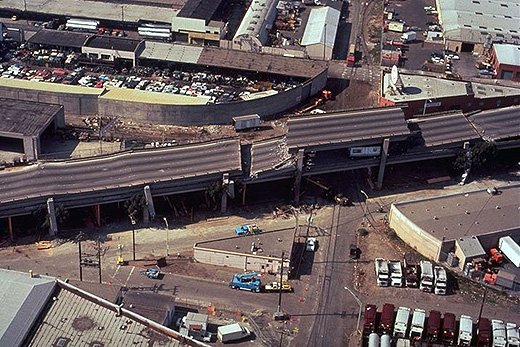
The Loma Prieta Earthquake, 1989

The Loma Prieta earthquake occurred on October 17, 1989, in the greater San Francisco Bay Area in California at 5:04 p.m. local time and measured 6.9 on the Moment magnitude scale (surface-wave magnitude 7.1). It occurred during the 1989 World Series, which happened to match up the Bay Area's two Major League Baseball teams, the Oakland Athletics against the San Francisco Giants. The earthquake lasted for 15 seconds. Its epicenter was at geographical coordinates 37.04° N 121.88° W south-southwest of Loma Prieta Peak in the unincorporated area of Aptos. This location, in the Santa Cruz Mountains' Forest of Nisene Marks State Park, is about ten miles (16 km) northeast of the city of Santa Cruz, California. The focus point was at a depth of 16.79 km, or 10 miles.

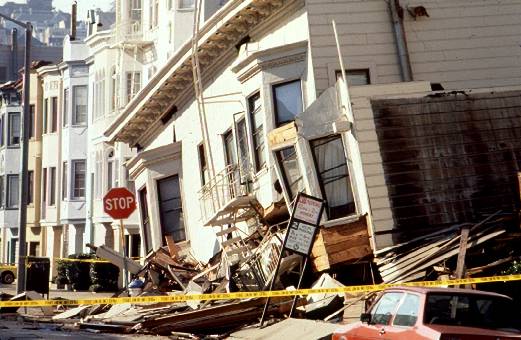
The Loma Prieta was a major earthquake, and caused severe damage as far as 50 miles away from its epicenter; most notably in San Francisco, Oakland, the San Francisco Peninsula, and in areas closer to the epicenter in the communities of Santa Cruz, the Monterey Bay, Watsonville, and Los Gatos. Most of the major property damage in the more distant areas resulted from liquefaction of soil used over the years to fill in the waterfront and then built upon.

The magnitude and distance of the earthquake from the severe damage to the north were surprising to geotechnologists. Subsequent analysis indicates that the damage was likely due to reflected seismic waves - the reflection from well-known deep (about 15 miles) discontinuities in the Earth's gross structure.

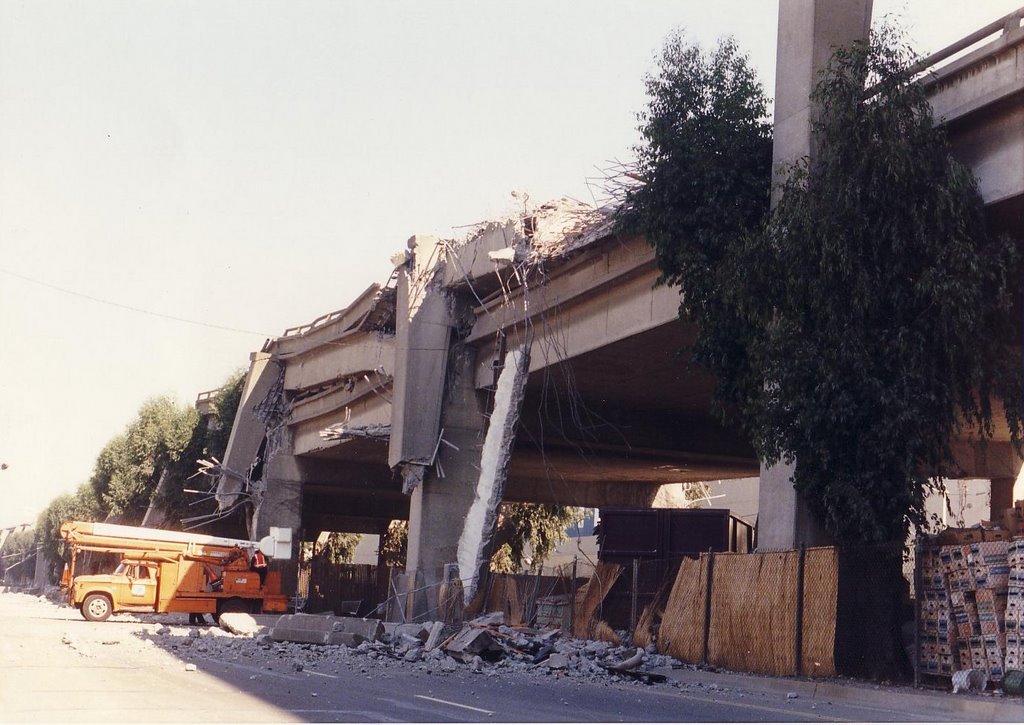
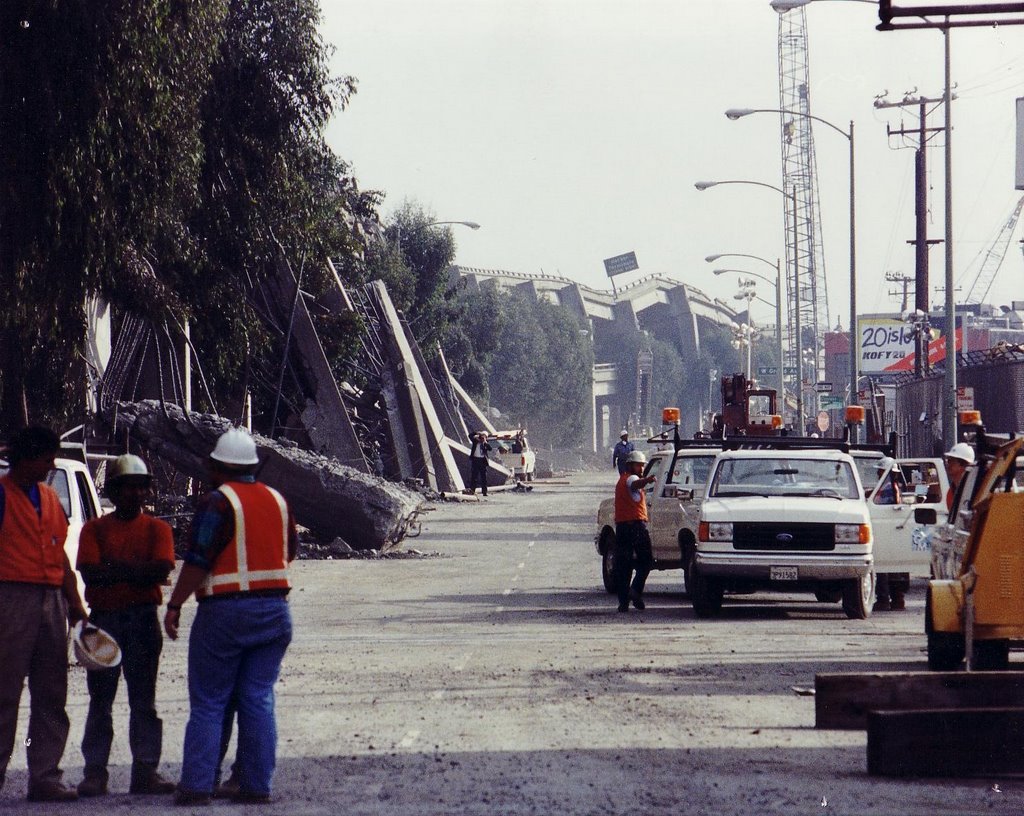
There were 57 deaths directly caused by the earthquake, and six more deaths were ruled to be indirectly caused by the temblor[1]. In addition, there were 3,757 injuries as a result of the earthquake. The highest concentration of fatalities, 42, occurred in the collapse of the Cypress Street Viaduct on the Nimitz Freeway (Interstate 880), where a double-decker portion of the freeway collapsed, crushing the cars on the lower deck. One 50-foot (15 m) section of the San Francisco-Oakland Bay Bridge also collapsed, causing two cars to fall to the deck below, leading to the single fatality on the bridge. The bridge was closed for repairs for a month and one day, reopening on November 18. While the bridge was closed, ridership on Bay Area Rapid Transit and ferry services soared, along with traffic levels on nearby bridges such as the Richmond-San Rafael and the Golden Gate.


The quake also caused an estimated $6 billion in property damage, the costliest natural disaster in U.S. history at the time. It was the largest earthquake to occur on the San Andreas Fault since the great 1906 San Francisco earthquake. Private donations poured in to aid relief efforts and on October 26, President George H.W. Bush signed a $3.45 billion earthquake relief package for California.


The Loma Prieta earthquake irrevocably changed the San Francisco Bay Area's transportation landscape. Not only did the quake force seismic retrofitting of all San Francisco Bay Area bridges, it caused enough damage that some parts of the region's freeway system had to be demolished. In some cases, the freeways in question had never been completed, terminating in mid-air; in that regard, the quake provided the impetus to deal with regional transportation problems that had gone largely unsolved for decades.


An automobile lies crushed under the third story of this apartment building in the Marina District. The ground levels are no longer visible because of structural failure and sinking due to liquefaction.

 
Nature Wallpapers Copyright © 2013 Blogger Template Designed by Bie Blogger Template